Showing posts with label 24 Hours of Le Mans. Show all posts

Monday, December 2, 2013

Delta Wing consortium files lawsuit that could derail Nissan ZEOD RC and Blade Glider

The Nissan DeltaWing entry in the 2012 24 Hours of Le Mans was built by a consortium of companies, and its official name was "Delta Wing Project 56" (DWP56).   That detail is leading to a lawsuit, from the leader of the project team, that could derail the Nissan ZEOD RC and the commercialized Blade Glider that could go into production. 

A complaint was filed and entered into the system of the superior court of Jackson County, Ga., on Friday, Nov. 22, 2013, by Delta Wing, LLC, a business owned by Chip Ganassi, and Delta Wing Project 56, LLC, a business with multiple owners, including Ganassi and general manager Don Panoz.

The issue arises because the original designer of the Delta Wing, Ben Bowlby, now works for Nissan and is in charge of designing the ZEOD RC and the Blade Glider.  Both use a triangular shaped vehicle body with improved aerodynamics.  What makes these vehicles important for us on Electric Race News is they both incorporate an electric drive train.

The claim by DWP56 is that Don Panoz and the DWP56 consortium bankrolled the design, and therefore owns intellectual property rights, which they are seeking to license to automakers. 

According to racer.com (link below) Bowlby, while an employee of Ganassi Racing, originally developed the idea as a proposal to the IndyCar series to replace an earlier Dallara design.  However, IndyCar chose to stay with Dallara.  Bowlby eventually hooked up with Panoz who bankrolled more design work, and formed DWP56 who took over intellectual property rights on the design.  The focus was a run at Le Mans in Garage 56, which is reserved for experimental race cars.  The role Nissan took was to supply an engine and presumably some other sponsorship resources required to get to Le Mans.  Unfortunately the car crashed after 7 hours and was unable to finish that race.  It returned to the Petit Le Mans later in the year, and then in 2013 it raced under the DeltaWing name without Nissan's blessing and sporting a Mazda engine.

Last summer, Bowlby showed up as a Nissan NISMO employee and leading the ZEOD RC project, after having been hired by Nissan in 2012.  That car is slated for the 2014 24 Hours of Le Mans and again occupying Garage 56, as did the original Delta Wing. 

The complaint names former Delta Wing designer and current Nissan director of motorsport innovation Ben Bowlby, Nissan global motorsports director Darren Cox, Nissan Motor Company, Ltd., Nissan Motorsports International Company, Ltd., Nissan International, S.A., and Nissan North America, Inc., and requests a finding of “temporary and permanent injunctive relief, interlocutory injunction, and damages.”

The complaint states: “This is an action for damages and injunctive relief arising out of theft of confidential and proprietary information, misappropriation of trade secrets, breach of contracts, unjust enrichment, fraud, and negligent misrepresentation. The Defendants have acted individually, as agents for each other, and in conspiracy with each other to commit the aforementioned actions, which have caused Plaintiffs damages and irreparable harm. ... Defendants have misappropriated the trade secrets owned by DW and exclusively licensed to DWP56 and used such information and opportunities to compete with DW and DWP56, causing irreparable and ongoing injury to Plaintiffs. Defendants have further breached their contracts with DWP56 and engaged in fraud and negligent misrepresentation directed toward DWP56, which have caused DWP56 significant damages”

Nissan's statement is: “The Nissan ZEOD RC is a new design. Nissan does not green light any projects which it believes will contravene third parties' intellectual property rights.”


This has me scratching my head ...

Bowlby was covered by employment agreements restricting him from revealing intellectual property developed by Ganassi/DWP56.  Nissan surely has good quality lawyers who can spot such a problem from the outset, and they chose to hire Bowlby anyway.  Ergo...?

At the same time, are triangularly shaped vehicles all that rare?  In other words, is the DWP56 design all that original? 

In the meantime - the ZEOD RC / Blade Glider - I've been meaning to write these up, and have neglected doing so.  My apologies.

Sources:
http://www.racer.com/panoz-led-delta-wing-consortium-files-lawsuit-against-ben-bowlby-and-nissan/article/323046/

http://transportevolved.com/2013/12/02/nissan-faces-legal-action-over-bladeglider-concept-ev/

Friday, June 21, 2013

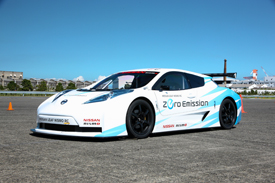
Nissan unveils ZEOD RC electrified race car prototype slated for 2014's 24 Hours of Le Mans

Nissan NISMO ZEOD RC electrified race car
Nissan is definitely heading to the 24 Hrs of Le Mans Garage 56, in 2014, with an electric race car. The Nissan ZEOD RC, for Zero Emission On Demand Racing Car, is being designed for drive train flexibility to use both electric motors, battery packs, and petrol engines in different ways with simple reconfiguration choices.  The ZEOD RC is not a 100% battery electric race car, because obviously at this stage of EV drive trains no such car could handle a 24 hours endurance race.  Instead Nissan see's the ZEOD RC as a test bed with which to "test the potential" of their future LM P1 power train.

Nissan's goal is to return, in the future, to Le Mans P1 competition, and gaining overall wins using an electrified LM P1 drive train.  The first step is the ZEOD RC, with a 300 km/hr top speed, slated for the 2014 Le Mans race via Garage 56.  That garage is reserved for experimental technology vehicles such as the 2013 hydrogen fuel cell entry, the GreenGT, which unfortunately pulled out.

To aim for winning Le Mans overall with an electrified drive train is a big goal.  We like that.

Since the ZEOD RC isn't a 100% battery electric car, then what is it?  In a press conference to unveil the car, a Nissan representative talked about how in some ways regular road cars are ahead of race cars - turbo-charging technology has been downsized and applied to smaller engines, not for high performance but for higher efficiency - electric cars, like the Nissan Leaf, are on the market and slowly ramping up sales.

Reading between the lines of his statement, the ZEOD RC will use a combination of a small turbo-charged fuel efficient engine, coupled with an all electric drive train with a battery pack.  The exact details have not been announced yet, because Nissan has not finalized the design.  Instead, they're at the beginning of the design work, and has "a number of other ideas under development that will be looking to test in the chassis" according to Andy Palmer, Executive Vice President of Nissan Motor Corporation.

Ben Bowlby, Nissan's Director of Motorsport Innovation, positioned the ZEOD RC in contrast to the hybrid cars Audi and Toyota are racing in the FIA World Endurance Cup.  Both those cars have been beating the pants off the competition, and are using hybrid technology, but with a KERS system rather than a hybrid electric system.  That means Audi and Toyota are using a form of regenerative braking that mechanically captures kinetic energy, releasing bursts for acceleration out of corners.  The ZEOD RC instead is an electrified system, that will capture energy during braking etc, but do so electrically rather than mechanically.

Bowlby said "We're building an extremely flexible platform with which we'll be able to try multiple different options – even during the same multi-day test.  It is about experimenting and gathering data to work out how we use electricity to develop a competitive LM P1 program in the future.  We will be working very closely with the ACO throughout the test program to help develop where this technology fits within the Le Mans rules package."

They expect to be able to run laps at Le Mans faster than a Ferrari GT car, which will be quite an achievement.  That means less than 4 minutes a lap.  There is no track record for electric cars at Le Mans, so anything Nissan does with the ZEOD RC will set the Le Mans electric car track record.

The car shown at Le Mans is based on the Nissan DeltaWing.  It has a narrow front end, and a wing-like shape (hence the name).  That car occupied Garage 56 in the 2012 24 Hrs of Le Mans.

The electric part of the drive train is to use similar components (but not identical components) as are used in the Nissan Leaf.  That means similar battery, inverter and motor technology but beefed up for the rigors of 300+ km/hr at Le Mans.

They aim to use the ZEOD RC as a test bed to develop these technologies, not just for a future electrified LM P1 race car, but for application to commercial electric cars sold to the public.

With the Nissan Leaf having sold over 65,000 units world-wide, Nissan rightly see's themselves as a world leader in electric cars.  The growth rate for sales of the Leaf is outstripping the first years of Toyota Prius sales by a good margin.

The theory presented by Nissan management is that by applying the same technology to race cars, they'll drive more awareness of electric drive train capabilities, while using the race track to accelerate technology development.  We totally agree with this theory, because that's the exact purpose I personally have for focusing on electric racing news.

"Nissan has become a global leader in the development of zero emission automotive technology, and the Nissan ZEOD RC will allow us to further develop those capabilities using the toughest endurance race in the world as a mobile test bed to test the potential of our planned LM P1 power train," said Andy Palmer, Executive Vice President and Executive Committee member at Nissan Motor Company Limited.

"The Nissan ZEOD RC is a natural progression that follows on from the development of the Nissan LEAF road car and the LEAF RC race car prototype. The technologies developed through the ZEOD RC program will form part of future innovations for Nissan road cars.

"Nissan is already a global leader in the sale of all-electric cars and we're eagerly awaiting the opportunity to showcase the lessons learnt with the development of battery technology in the world's oldest, toughest and most high profile endurance race.

"The ZEOD RC program is designed to develop multiple technologies to evaluate how they could be used for a future LM P1 class return of Nissan at the Le Mans 24 Hour. There are multiple options we are investigating. A Zero Emission on Demand option where the driver can switch between electric and petrol-powered drive is a future direction for road cars, so that will be tested in addition to pure electric power and other new technologies that we still have under development.

"As no other manufacturer is using electric battery technology in endurance racing today, Nissan is innovating again and this will provide us with significant amounts of data and information to evaluate potential powertrains for future sportscar programs and allow us to continue as the leader in Zero Emissions technology on the road."


"Developing a car like this provides an incredibly challenging test bed for what could be highly effective options for road cars of the future. Throughout the next twelve months we will be testing multiple drive train options in an extensive test program," Bowlby said.

"We have many options to consider and test. The test program is part of a longer term goal of developing a system and a set of rules for this type of technology in partnership with the ACO that would be best suited to competing at the highest level of this sport.

"Nissan is a leader in electric vehicle technology for the road, now we want to take those lessons learnt and utilize that knowledge base in the development of the new race car.

"Our design team on the Nissan ZEOD RC program has concentrated heavily on packaging and aerodynamic efficiency that will not only provide extreme performance but high levels of energy efficiency – the goal for all global automakers.

"A large part of our work in the coming months is to discuss with the ACO future opportunities for the 'electrification' of the Le Mans rules in the future and work towards delivering appropriate technology. Garage 56 is a bold move by the ACO to showcase Innovation and allow testing of untried components and systems for future competition use. To this end they are the most forward thinking promoter in Motorsport today."

Sunday, June 2, 2013

Hydrogen fuel cell race car, GreenGT H2, pulls out of 24 Hrs of Le Mans

GreenGT H2
Those of you hoping for a hydrogen fuel cell powered race car, in the 24 Hours of Le Mans, prepare to be disappointed.  The GreenGT entry in that race, a hydrogen fuel cell race car, has just pulled out of the event.  While they were able to show the race car on the track, one reads between the lines that they weren't quite ready for a 24 hours endurance race.

According to a press release issued on Saturday June 1, the team will continue testing the GreenGT H2 until June 5.  Performance is in line with test bench results.  However, the press release explained that "the highly complex phase of fine tuning the high power hydrogen fuel cell is in conflict with the on track endurance test programme, an essential requirement for participation in a demanding race like the Le Mans Classic event."

Managing director Jean-Francois Weber saying: "The GreenGT H2 is already showing great potential and has great scope for improvement. However, the complexity and cost of this unique model requires the use of extremely rigorous methods and very time-consuming new procedures.  We are only at the beginning of this adventure, and it is essential for us not to cut corners and continue the development of the GreenGT H2."

Jean Michel Bouresche, Sales & Marketing Director of GreenGT, says: "First of all, we wish to thank ACO for its confidence in GreenGT. Box 56 is a splendid initiative for encouraging innovative technologies. The GreenGT H2 fits perfectly in to this scenario and, although the Le Mans 2013 event has come too soon for us, we are actively working with ACO on a worldwide presentation programme for the GreenGT H2. The names of world famous drivers will be announced at the 24 Hours of Le Mans. They will be our ambassadors for the presentation of this technology of the future."

Vincent Beaumesnil, Sports Director of ACO, says: "The technology of the GreenGT H2 is perfectly in line with the spirit of innovation that ACO intends to promote with Box 56. It works, and the ACO was right in believing in the technological merits of this project. But the 24 Hours of Le Mans is a high endurance event, and it is premature for the GreenGT H2 to take up this challenge. However, we will continue to support this initiative and, together with GreenGT, we will soon announce a world wide demonstration tour which will take place during the same week as the 24 Hours of Le Mans and, possibly, an unranked presence at the start of a World Endurance Championship race, as the regulations allow the presence of this type of vehicle on the starting grid."

Tuesday, February 26, 2013

Nissan building 24 Hours of Le Mans electric race car

Nissan says they will return to the 24 Hours of Le Mans in 2014, with an electric race car.  Maybe.  The press release isn't precise enough to be certain, but it did promise an "all-new race car incorporating electric technology."

Nismo LEAF RC Electric Race Car
That's enough to make our minds to "whuuuh??"  Let's first start with carefully describing Nissan's announcement before pondering what this means.

Nissan President and Chief Executive Officer Carlos Ghosn made the pledge to return to Le Mans during a special event today in Yokohama, Japan to open a new headquarters for NISMO, Nissan's global performance and motorsports brand.

He talked about "a new approach to innovation and excitement [that] will be at the project's core" and confirmed that Nissan's 2014 Le Mans entry will be the "Garage 56" entry for innovative concepts with an all-new race car incorporating electric technology.  I don't know Le Mans, but from reading other reports on this Garage 56 is reserved for experimental vehicles, in 2012 it was occupied by the Nissan Delta Wing, and in 2013 it will be occupied by a hydrogen fuel cell race car dubbed the GreenGT.

"We will return to Le Mans with a vehicle that will act as a high-speed test bed in the harshest of environments for both our road car and race car electric vehicle technology," said Mr. Ghosn.

The vehicle will apparently serve two purposes:
  1. Test innovative new powertrain technology
  2. Provide the Automobile Club de l'Ouest (ACO) and the Federation Internationale de l'Automobile (FIA) with data to enable all parties to evaluate the incorporation of this breakthrough technology
That's about it other than a promise to release more details soonish.

Now we get to ponder about how Nissan could plausibly run an endurance race with an electric race car.  Electric cars in general have lower energy density than petrol cars, which is the key to their limited driving range.  The petrol race cars do make pit stops to refuel, but those stops are typically a minute or whatever minimal length of time to put the least impact on race results.  Electric cars however require a long recharge time, relatively speaking.

First - is this going to be an all electric car?

The press release does not use phrases like "zero emissions" or "all electric."  It instead says "race car electric vehicle technology" which I find to be imprecise enough that I'm not convinced this will be an all electric car.  However, if it were to be a hybrid race car they would have said so, right?

Maybe it is an all electric car?

Second - if it is an all electric car, how can they hope to make more than a couple laps with it?  That is, the Drayson electric race car lasts for 15 minutes or so of racing time.  The Formula E electric race cars will have a similar racing time, and in that series they'll be using four cars per team for a continuous race.

There are two ways to go about a longer race format like a 24 hours endurance race in an electric car.
  1. Swappable battery packs, with charging in the pit
  2. Fast charging
I've seen a 24 hour endurance race run with electric vehicles - the 24 Hours of Electricross staged by Zero Motorcycles in 2009.  In that case each team had 3 battery packs, one on the bike, and the other two in the pit charging.  The Zero bikes used in that event have fast swap battery packs that can be exchanged within a minute or so, which let the rider exit the race, swap the packs, and a fresh rider get on the track, all in a jiffy.

It's plausible then that a fast swap battery pack could enable an electric race car to run for 24 hours.  I can hear the question:  Isn't that cheating, compared to petrol race cars?  No, it isn't.  It's the equivalent of the petrol driven race cars refilling the fuel tank.

Thursday, September 6, 2012

Lightning leads after first qualifying round at e-Power/TTXGP Le Mans joint race

As I noted the other day, the Barracuda Lightning Motorcycles Racing team has gone to Le Mans for the e-Power/TTXGP race.  As expected the teams rider, Miguel Duhamel, is at the top of the results sheet for todays practice round, beating Matthias Himmelmann of Muench Racing.  Why expected?  Because of how far back Himmelmann finished behind the Lightning bikes at the Laguna Seca race.

At Laguna Seca, Himmelmann finished the race 16.325 seconds behind Michael Barnes on the Barracuda Lightning #80, and had a best lap time 1.927 seconds slower.  With a top-notch rider like Duhamel, the Lightning race bike should perform just as well as if Barnes were riding, and I expected that Lightning would win over Himmelmann/Muench again.

Miguel Duhamel


The results were:

#1, Barracuda Lightning, Miguel Duhamel, 1:49.200 best lap, 137.802 km/hr
#2, Muench Racing, Matthias Himmelmann, 1:50.834 best lap, 135.771 km/hr
#3, Zongshen Racing, Ho Chi-Fung, 2:05.431 best lap, 119.970 km/hr
#4, Muench Racing, Katja Poensgen, 2:05.677 best lap, 119.736 km/hr

Additionally three racers are shown as "Not classified" as being slower than the qualification time of 2:18.186 best lap time.

#5, epo-bike.de, Christian Amendt, 2:18.754 best lap, 108.451 km/hr
#6, Zongshen Racing, Tang Yu, 2:30.469 best lap
#7, Zongshen Racing, David Dumain, no stats listed

I don't know if this means these riders have no chance to qualify tomorrow or not.  The FIM e-Power series follows a qualification rule that, in essence, requires bikes to be within a given speed percentage of each other.  The three bikes name fell below that percentage.  Todays race is described as "first qualifier" so perhaps they'll be allowed a second chance in the second qualifier tomorrow.

Christian Amendt "was held up by problems with his electric motor".

Tang Yu "was stymied by a crash".

David Duhamel, is also driving in the 24 Hours of Le Mans race, and "fell in the qualifiers and was unable to take part in the first e-Power practice session."

Miguel Duhamel, 17 – Lightning Barracuda Racing Team

« I am pretty satisfied with my qualifying, said Miguel Duhamel, but I could have done better. I spent the last three years on my couch and I need to give myself a bit of a shake to get back into a competitive frame of mind. The motorcycle is going well and I am sure I shall be faster tomorrow. »

Matthias Himmelmann, 49 - Munch Racing TT

« After our big problems in Oschersleben, I am really pleased with this qualifier. I lapped in 1’50 compared to 1’52 last year. This weekend is very important as it will decide both the e-Power and TTXGP championship titles. »

The second qualifying round will be held at 10:00 AM on Friday, with the race proper at 4:35 PM on Friday.

Source: http://www.egrandprix.com/news.php?id=311


Sunday, June 17, 2012

Audi in historic first Hybrid Race Car win at 24 Hours of Le Mans

At the famed 24 Hours of Le Mans endurance race, Audi made a historic achievement with the first hybrid cars to win that race.  While the title of this site is Electric Race News, we'll mark this achievement under the rubric of "Electrified Vehicle Racing" because it was an electrified vehicle which won the race.

The vehicle in question was four Audi R18 e-ton Quattro's.  With this car Audi Sport Team Joest took 1st, 2nd, 3rd and 5th places in the 24 Hours of Le Mans endurance race.

Audi R18 e-tron quattro #1 (Audi Sport Team Joest), Marcel Fassler (CH), Andre Lotterer (D), Benoit Treluyer (F)

“By achieving this further success at the world’s most important endurance race our engineers demonstrated their high technological expertise in a particularly impressive way,” commented Rupert Stadler, Chairman of the Board of Management of AUDI AG, who personally watched the race on location. “With the e-tron quattro in combination with ultra lightweight design, we put a completely new technology on the grid and immediately won with it – this cannot be taken for granted by any means, particularly here at Le Mans. This weekend again showed the type of things that can happen in this race and how important perfect preparation is.”

The winning group, consisted of drivers Marcel Fässler (CH), André Lotterer (D) and Benoît Tréluyer (F), who were also the winners of the 2011 24 Hours of Le Mans.

Audi describes the drive train as the "all-wheel drive of the future in which the conventional drive system is intelligently combined with an electrically driven axle." Audi is already testing this technology in which the drive shaft is replaced by electric cables for use in production vehicles. Operating at the rear of all four Audi R18 cars was the latest evolution of the compact V6 TDI engine with VTG mono turbocharger that was used at Le Mans for the first time in 2011. The new ultra-light transmission with a carbon fiber housing – a novelty in a Le Mans sports car – held up to the Le Mans endurance test covering a distance of 5.151 kilometers in all four vehicles without any problems as well. Like quatto all-wheel drive, ultra-lightweight design is a core competency of the company.

In addition to this marking the first time a hybrid car has won the 24 Hours of Le Mans, it was also the first time a hybrid car took the pole position to open the race. André Lotterer in the Audi R18 e-tron quattro designated as car number “1” to achieve a fastest lap of 3m 23.787s in the final qualifying session on Thursday night shortly after 22:00 – and thus an improvement of last year’s best time by nearly two seconds. André Lotterer in the Audi R18 e-tron quattro designated as car number “1” to achieve a fastest lap of 3m 23.787s in the final qualifying session on Thursday night shortly after 22:00 – and thus an improvement of last year’s best time by nearly two seconds.

Le Mans record winner Tom Kristensen in the number “2” Audi R18 e-tron quattro set the fourth-fastest lap (3m 25.433s) behind the quickest hybrid vehicle from Toyota. Le Mans rookie Marco Bonanomi in the number “4” Audi R18 ultra took grid position six (3m 26.420 s. This meant that all four vehicles fielded by Audi Sport Team Joest qualified for the three front rows.

Audi is fielding two varieties of the Audi R18 in this years FIA World Endurance Championship (WEC); the R18 ultra and the R18 e-tron quattro. This first diesel hybrid race car at Le Mans fundamentally differs from the conventionally powered model in some respects. The e-tron quattro, for example, has an electrically driven front axle in addition to the conventional rear-wheel drive, a motor generator unit (MGU) on the front axle, a rotating mass storage device, an additional cooling system and new detailed solutions.

"This makes it all the more surprising that our engineers have implemented a principle featuring a high level of carry-over parts,” emphasizes Dr. Ullrich in praise of his team’s achievements. "The R18 ultra is the basis that has made it possible to make the R18 e-tron quattro reality in the first place. We would have had no chance if we hadn’t achieved the weight saving between our 2011 Le Mans winner, the R18 TDI, and the current R18 ultra because we had to additionally package the entire hybrid system in the vehicle. And in spite of this, we continued to pursue the aim of staying below the minimum weight of 900 kg in order to have some latitude to balance the car with ballast.”

Audi R18 e-tron quattro #1 (Audi Sport Team Joest), Marcel Fassler (CH), Andre Lotterer (D), Benoit Treluyer (F)
Start with leading Audi R18 e-tron quattro #1 (Audi Sport Team Joest), Marcel Fassler (CH), Andre Lotterer (D), Benoit Treluyer (F)

Audi R18 ultra #3 (Audi Sport Team Joest), Romain Dumas (F), Loïc Duval (F), Marc Gene (E)
Audi R18 e-tron quattro #1 (Audi Sport Team Joest), Marcel Fassler (CH), Andre Lotterer (D), Benoit Treluyer (F)


Technical data Audi R18 e-tron quattro / ultra (2012)


Version: February 2012


Model VehicleAudi R18 e-tron quattro / ultra (2012)
Vehicle typeLe Mans Prototype (LMP1)
MonocoqueCarbon-fiber composite with aluminum honeycomb, tested according to the strict FIA crash and safety standards
BatteryLithium ion batteries
EngineTurbocharged 120° V6, 4 valves per cylinder, DOHC, 1 Garrett turbocharger, mandatory intake air restrictor of 1 x 45.8 mm diameter and turbo boost pressure limited to 2.8 bar absolute, diesel direct injection TDI Fully stressed aluminum cylinder block, diesel particle filter
Engine managementBosch MS24
Engine lubricationDry sump, Castrol
Displacement3,700 cc
Power Over375 kW / 510 hp
Torque Over850 Nm
Hybrid system*
Type of accumulatorElectric flywheel accumulator, max 500 KJ, WHP
Motor Generator Unit (MGU)MGU on the front axle, water cooled with integrated power electronics, 2 x 75 kW
Drive / transmission
Type of driveRear wheel drive, traction control (ASR), four-wheel drive e-tron quattro from 120 km/h*
Clutch Carbon clutchGearbox Sequential, electrically activated 6-speed racing gearbox
DifferentialLimited-slip rear differential
Gearbox housingCarbon-fiber composite with titanium inserts
DriveshaftsConstant velocity sliding tripod universal joints
Suspension / steering / brakes
SteeringElectrical assisted rack and pinion steering
SuspensionFront and rear double wishbone independent suspension, front pushrod system and rear pull rod system with adjustable dampers
BrakesHydraulic dual circuit brake system, mono bloc light alloy brake calipers, ventilated carbon disc brakes front and rear, infinitely manually adjustable front and rear brake balance
WheelsO.Z. magnesium forged wheels
TiresMichelin Radial, Front: 360/710-18, rear: 370/710-18
Weight / dimensions
Length4,650 mm
Width2,000 mm
Height1,030 mm
Minimumweight 900 kg
Fueltank capacity 58*/60 liters
*Different specification for R18 e-tron quattro