Monday, November 7, 2011

Brigham Young students set electric land speed record with their electric car

Brigham Young University officials have announced that their student-built electric car has set another Bonneville speed record.  The car, nicknamed “Electric Blue” was built by BYU engineering students and was competing in the Streamliner E1 class.  The BYU team had no problem busting the 130 MPH barrier. Their two runs had an average speed of 155.8 MPH with one of the runs clocking in at blazing 175 MPH.

Bullet-shaped electric car sets speed record

American Students Set New Electric Vehicle Land Speed Record


Friday, November 4, 2011

Drayson Racing teams with Vantage Power to develop electric race cars

Last year Vantage Power built an electric race car and drove it the full length of the Pan-American Highway in an endurance challenge.  Now they are teaming up with Drayson Racing to develop high performance electric cars.

Drayson Racing is the racing team formed by Lord Drayson, they race in gas races and for the last couple years have been working on electric race cars. 

They'll be focusing on high power long range EV development.  The quip for a long time is you can have fast, or you can go for distance, but you can't do both at the same time.  To do both at the same time would require an enormous battery pack.


Drayson Racing, Vantage Power & the RAC Future Car Challenge

Drayson Racing and Vantage Power team up to tackle the RAC Future Car Challenge and develop ultra high performance electric cars.

Enter first electric vehicle to drive the entire length of the Pan-American Highway in Brighton to London Challenge.

Form Technical Partnership to develop electric drivetrains with high performance and endurance
.

Drayson Racing Technologies LLP, the leading green racing R&D business, has teamed up with Vantage Power Ltd, the team behind the world record breaking SRZero electric car that last year drove the 26,000km Pan-American Highway in 70 days as part of the Racing Green Endurance project. Together, they will tackle the 60 mile RAC Future Car Challenge Race from Brighton to London on November 5th 2011, and look forward to a series of exciting events in the future.

Vantage Power Ltd and Drayson Racing Technologies LLP also announced today the formation of an official technical partnership which aims to combine Vantage Power’s experience in extreme endurance runs with Drayson Racing’s know how in high performance motorsport, to develop drive trains for electric vehicles with both high performance and long range.

The SRZero will be driven in the RAC Future Car Challenge by the co-founder of Drayson Racing, former Science Minister and Le Mans racing driver Lord Paul Drayson, and the Head of Imperial College’s Energy Futures Laboratory Prof Nigel Brandon.

Quotes:

Paul Drayson said:
“For electric cars to really take off we need to show that they can offer the performance and range that consumers expect from modern cars. Although 60 miles is a lot less than the 26,000 km that the Vantage Power team achieved last year – and the 70 mph speed limit a bit less than the 220 mph plus we target when racing, it will be fun driving the car and competing in this exciting event. Participating in the RAC Future Car Challenge is a great way to showcase the experience and know how that Drayson Racing and Vantage Power bring in developing electric cars that offer both high performance and long range.”

Alexander Schey, Managing Director of Vantage Power, said:
“After completing the Pan-American challenge with the SRZero, Vantage Power is looking forward to the collaboration with Drayson Racing, and building upon its extensive experience by applying it to the vanguard of the high performance electric vehicle industry. The RAC Future Car Challenge, though different to the style of driving both Vantage Power and Drayson racing are used to, will demonstrate our desire to participate in a range of events as well as our motivation to win them!”

Tuesday, October 18, 2011

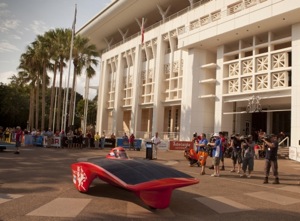
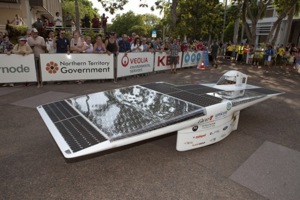
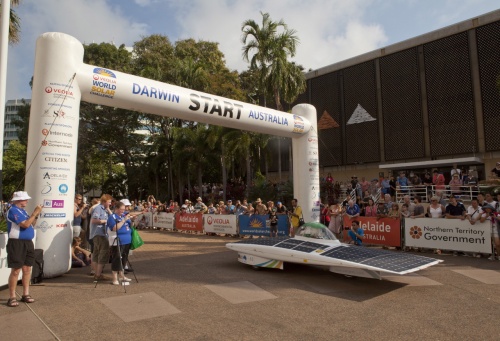
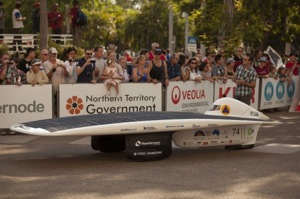
Solar Race Cars spreading across central Australia as World Solar Challenge ends 3rd day - Team Tokai way ahead

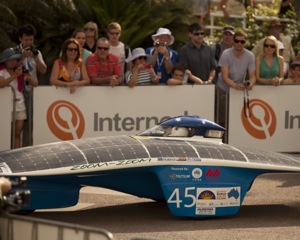
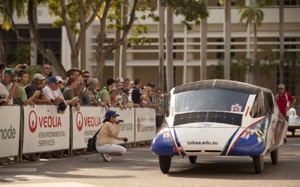
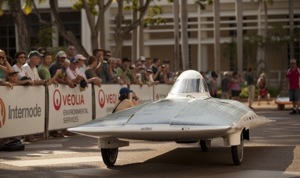
The 2011 installment of the World Solar Challenge, a solar car race that runs through central Australia, is underway.  The cars are purpose built vehicles that sit low to the ground, have extreme aerodynamics, and the whole top is generally covered in solar panels.  The race goes from Darwin (on Australias North coast) to Adelaide, on the South coast, a total distance of 3000+ kilometers.   At the end of day 3 the cars are spread across Central Australia with a couple teams within a day or two of the finish line, and at least one team suffering a fire in their car.

282 start pic 4

Day 1 - Sunday 16th October 2011

Top 5 Teams

  1. Tokai University
  2. Nuon Solar Car Team
  3. University of Michigan
  4. Aurora
  5. Apollo Solar Car Team

Solar Team Twente ended the first day in sixth position after a bit of bad luck at the starting line.  A blown motor controller delayed their start by 20 minutes to replace the controller, and they ended up stuck in a traffic jam in Darwin.  By the first media stop 317 kilometers south of Darwin the car had overtaken 15 other cars and was in ninth position.

At the Dunmarra and Katherine checkpoints the Tokai, Michigan and Nuon teams were basically neck-and-neck.

http://www.worldsolarchallenge.org/files/296_day_1_2011_veolia_world_solar_challenge_timing_results.pdf

http://www.theregister.co.uk/2011/10/15/wsc_update/

http://www.theregister.co.uk/2011/10/17/solar_challenge_day_one/

Day 2 - Monday 17th October 2011

Top 5 Teams

  1. Tokai University
  2. Nuon Solar Car Team
  3. University of Michigan
  4. Aurora
  5. Ashiya University

Brushfires forced closure of the road for awhile.  The organization held a "control stop" at Wauchope 116km south of Tennant Creek, with the three leading teams at that stop.

Team Apollo was in fifth place, until they ran over cattle grid at 683 km south of Darwin.  The car suffered damage, and the scrutineers deemed it repairable.  They're expected to get it back on the road with a few hours delay.

http://www.worldsolarchallenge.org/files/300_2011_velolia_world_solar_challenge_day_2_provisional_results_2.pdf

http://www.worldsolarchallenge.org/files/301_day_2_provisional_results_end_of_day.pdf

http://www.theregister.co.uk/2011/10/17/world_solar_challenge_race_day_2/

Day 3 - Tuesday 18th October 2011

Top 5 Teams

  1. Tokai University
  2. Nuon Solar Car Team
  3. University of Michigan
  4. Ashiya University
  5. Aurora

Electric vehicles can burn, as the Team Phillipines car proved.  As the team made repairs to the vehicle the battery "exploded" and flames engulfed the car.  Nobody was injured and it's believed the damage is not terminal and the team can continue tomorrow.

Team Tokai has stretched their lead to 20 kilometers, or 35 minutes, with Nuon and Michigan behind them.  Tokai was also the first to cross the South Australian border meaning they've completed about 2000km of the race.

Another group of teams are 300km north at Alice Springs.

http://www.theregister.co.uk/2011/10/18/wsc_solarcar_race_update_day_three/

http://www.theregister.co.uk/2011/10/18/wsc_solar_car_race_day_3/

http://www.worldsolarchallenge.org/files/304_day_3_provisional_update_veolia_world_solar_challenge_tokai_crosses_the_border_as_philippines_batteryr_engulfed_in_flames_damage_hopefully_not_terminal.pdf

http://www.worldsolarchallenge.org/files/303_2011_velolia_world_solar_challenge_day_3_provisional_results.pdf


280 start line pic 1

281 start pic 2

283 start pic 5

284 start pic 6

286 start pic 7

287 start pic 8

288 start pic 9

289 start panorama1

290 start pic 11

291 start pic 12

292 start pic 13

294 start line 14

295 start line 15

Batch1313028177 world solor challenge111


Peugeot 908 Hybrid 4 has track test at Estoril on 11 October

The Peugeot 908 Hybrid 4, which was unveiled at the 2011 Geneva Motor Show in March, made its first genuine on-track test at Estoril, Portugal on October 11, 2011.

"Our aim wasn't to but a lot of kilometres on the clock, but to verify that all the chief functions performed," reports Peugeot Sport's Technical Director, Bruno Famin. "It was important to analyse the data of each run to be sure we understood the results before moving on to the next step. The system functioned well and responded as predicted, which was very satisfying. At the same time, we started to make a few adjustments to the car's basic set-up. It worked well, so that's very positive."

Nicolas Minassian: "I had the good fortune to drive the original demonstration hybrid car in 2008 and I am proud to have been the first person to drive the 908 HYbrid4. It's extremely interesting to work on a project of this scale which no doubt paves the way for the future of motor racing. As a driver, it's very rewarding to be in a position where you can learn and play a part in the development of new technologies."

Stéphane Sarrazin: "We were able to work through the complete test programme, so that was fantastic. It was interesting to work with the engineers to identify the ideal compromises and, of course, get acquainted with the system, since the project is only in its early days. You can feel the extra power and it will be up to us to harness or adapt it in the most competitive way possible. We will need to strike the right balance. We're looking at a lot of things and exploring several avenues."

"We spent 2010 designing the system ahead of an initial bench test at the beginning of 2011," explains Bruno Famin. "We have a dyno that allows us to test the complete engine, gearbox and transmission assembly. This is particularly practical since it functions just as it does when fitted to the car. The hybrid system forms an integral part of the power train. This test work continued through 2011 up to the car's first shakedown run in September and its first real track test a few days ago."

"It will be interesting to see how the system performs at a different track," notes Bruno Famin. "A new phase will also begin when we start to fine tune not only the system but also the handling of the car We have no intention of rushing things, however. We are still on a learning curve and the endurance testing will come later."


http://www.supersport.com/motorsport/sports-cars/news/111017/Peugeot_hybrid_takes_to_the_track

MIST Suzuki Stop Smoking to join the TTXGP World Championship 2012

Hot on the heels of the 2011 TTXGP World Championship race, the following announcement was sent out naming a new team joining the race series for 2012.  MIST Suzuki Stop Smoking is expected to compete in the European series.

Going by their blog post they're planning to build their own electric superbike.

They appear to have been duly impressed by the Laguna Seca race during which the top bike (Mission Motors) turned in lap times within shouting distance of the MotoGP bikes.  Team owner Mike Edwards said “We’ve long been converts to the benefits of electric motorcycle racing. 2011 was a landmark season with the fastest electric bike qualifying just ten seconds off Jorge Lorenzo’s pole position time in the MotoGP race at Laguna Seca. That’s a huge step and I can’t imagine any electric cars getting that close to F1 cars anytime soon. With technology progressing at the current rate we are confident that gap will start to close even further and look forward to building a competitive bike that will help set new benchmarks in electric motorcycle racing. It is tremendously exciting as there are few opportunities outside of the MotoGP race paddock where can you design and build a complete machine from a clean sheet of paper.”


http://www.mistsuzuki.com/

http://www.mistsuzuki.com/2011/10/18/stop-smoking-for-2012/

MIST Suzuki Stop Smoking to join the TTXGP World Championship 2012

MIST Suzuki Racing are pleased to announce the team has reached agreement with Azhar Hussain MBE, founder of the TTXGP electric motorcycle championship, to build an electric motorcycle in time for the 2012 championship and to compete in the European, and hopefully the World, championships. Making the switch from the long established fossil fuel powered racing to the emerging world of renewable green energy is a big step but one the team are looking forward to making.

Team owner Mike Edwards said "We've long been converts to the benefits of electric motorcycle racing. 2011 was a landmark season with the fastest electric bike qualifying just ten seconds off Jorge Lorenzo's pole position time in the MotoGP race at Laguna Seca. That's a huge step and I can't imagine any electric cars getting that close to F1 cars anytime soon. With technology progressing at the current rate we are confident that gap will start to close even further and look forward to building a competitive bike that will help set new benchmarks in electric motorcycle racing. It is tremendously exciting as there are few opportunities outside of the MotoGP race paddock where can you design and build a complete machine from a clean sheet of paper.".

TTXGP founder Azhar Hussain was equally enthusiastic: "We are incredibly pleased to welcome the MIST Suzuki team to the TTXGP family. They bring with them world class motorsport experience from WSBK and BSB. We believe MIST are a fantastic example of what can be achieved when TTXGP integrates it's technical support with the passion and motorsport heritage that Mike and his team bring to the next generation of motor sports. Their involvement brings us closer to our goal to have the most competitive and thrilling grid anywhere in the world for clean emission zero carbon racing.".

MIST bring with them a number of highly experienced technical partners, ranging from chassis design and build expertise to the MotoGP and World SuperBike race paddock, class leading electronics firms looking to develop their top SuperBike products for the electric bike market plus a number of battery and controller experts from other highly experienced electric vehicle manufacturers.

Mike added: "We are holding talks with a production company about making a documentary on the design and development process, showing the project from it's inception through the build and testing to the first race of the season. We have some world leading electric motor and battery expertise in this country and, when combined with some of the extremely talented motorcycle chassis designers, the goal has to be to use the combined talent of our team and our partners to fly the flag for British engineering and technology on the world stage."

"We also plan to continue the development of the World Superbike spec. Suzuki we have been building this season and will use it as the benchmark for both the electronics and handling targets for the new project. We may even complete a WSB wild card or two to help publicise the TTXGP entry.".

For further details please get in touch with the team via the website at www.mistsuzuki.com or email at 'info@mistsuzuki.com'.

About MIST Suzuki Racing

Team owner Mike Edwards, one of the original founders of the MiniTwins race series, set up MIST Suzuki Racing to provide a path for young riders to reach the top levels of international racing. The path led from points scoring finishes against factory supported teams during their three year tenure as one of the largest British teams in the World SuperBike paddock, to podium finishes, race wins and multiple lap records in the British SuperBike Evo class. The team was accepted to compete in a number of wild card races at World SuperBikes in 2011 but had to postpone their plans until the following year due to issues obtaining the necessary parts in time. 

About TTXGP

TTXGP, the eGrandPrix is an international race series providing a high profile platform for the development of electric vehicles.  Using motorcycles as a resource effective development platform, TTXGP enables the futuristic technology behind them to be tested in an exciting and challenging way. TTXGP aims to drive low carbon technological innovation forward, to demonstrate that clean-emission transport technologies have matured and can be fun, fast and exciting.

Will electric Car Buyers Win as EV Racing Goes From Two Wheels to Four? Will Mavizen/TTXGP win in the shift to car racing?

“Electric racing offers the potential to both accelerate the development of electric drivetrain technology in the crucible of competition, but also to show how exciting zero-emissions race cars can be and so shift consumer attitudes towards the adoption of EVs,” said Drayson Racing chief Lord Paul Drayson.  So far the most widely known electric racing action has been the TTXGP electric motorcycle race series.  A recent Wired article talked about the application of electric motorcycle components to electric cars, both electric race cars, and cars meant for the public, as well as a shift to electric car racing when (?if?) the Formula E series launches in 2013.

Azhar Hussain's hope in launching the TTXGP was to, as Lord Drayson said in the quote above, accelerate electric vehicle technology via electric racing.   Hussain's other company, Mavizen, is looking to take technology they developed for electric motorcycle racing and apply it to electric car racing.  The claim is that any technological gains along the way might make their way into regular cars as well, and benefit us all.  Whether or not specific technologies make it from the track to consumer vehicles, electric vehicle racing action has a tendency to blow up the stereotype that electric cars can only be slow boring ugly golf carts.

The mantra in racing has long been “Win on Sunday, sell on Monday” - meaning, the race is on Sunday and the fans will often show up at the store on Monday looking to buy whatever they saw winning on Sunday.

Hussain owns two companies, Mavizen and TTXGP.  Mavizen is working with Drayson Racing on the technology for B12/69EV, their electric race car intended for the Formula E series expected to launch in 2013.  Mavizen is supplying the battery pack's for Drayson's race car.   The Wired news article (linked below) claims this battery pack design was used in the TTXGP electric bike racing series, but this is almost certainly inaccurate.  To understand we must review the history of Mavizen's technology.

During the 2010 season Mavizen leased several TTX02 race bikes to race teams.  Those bikes used battery packs with A123 cells.  However not all the TTXGP race teams used Mavizen's technology.  The Mavizen bikes generally gave middle-of-the-pack results compared to some other bikes on the grid - such as eCRP, Meunch Racing, and Lightning Motors.  Lightning's battery packs also used A123 cells, but using Lightning's own design rather than Mavizen's.  Mavizen's technology was not in any way impressive during 2010, except in-so-much that they managed to supply electric race bikes for six or so teams.  One of Mavizen's purposes was to enable there to be more racing teams on the TTXGP grid, and in 2010 they did so even though their teams generally gave poor-to-middling results.

In the 2011 season Mavizen did not lease out any bikes, and instead started a strategic move to become a parts and services organization rather than supplier of race bikes.  One move they made made was to become a reseller of A123 technology, both battery cells and complete battery packs.  They're also looking beyond the TTXGP electric motorcycle race grid for customers, such as their deal with Drayson and the Qimera electric race car.  I do not yet know whether the packs being sold to Drayson Racing are the A123 design, or Mavizen's design.

Mavizen's eye is on a future which is more than electric motorcycle racing, but also car racing.  Such as the Formula E series expected to launch in 2013.

See:

Electric racing vehicle and components suppliers in 2011

The changing role of Mavizen within the TTXGP

A123 Systems sponsoring the 2011 North American TTXGP race series

Mavizen signs battery distribution agreement with A123 Systems

Car Buyers Win as EV Racing Goes From Two Wheels to Four

http://snippets.electricracenews.com/2011/07/wireless-chargers-could-turn-ev-racers.html

Sunday, October 16, 2011

What's behind the small grid in today's TTXGP 2011 World Championship race

This weekend saw Matthias Himmelman (Muench Racing) win the TTXGP 2011 World Championship race at the Anglesey race track in Wales.  While congratulations are due to Himmelman and his team for their excellent win this year (see TTXGP 2011 World Final Championship held today by the Welsh seaside in Anglesey), the championship race had only four teams from the TTXGP Europe series participating.  No teams from North America or Australia attended, doubtlessly because of the five-day notice the teams received.

The TTXGP organization is unlikely to comment publicly on why this race had a small starting grid that wasn't representative of the world-wide racing action under the TTXGP banner the last two years.  But we know some effects that contributed to the situation.

Trio

A major story of the season was the attempt for TTXGP and FIM's e-Power to hold joint racing events.  In 2011 there were to be three such joint events, in Laguna Seca in July, at Le Mans in September, and a "to be announced" location and time for the final race.  As time ticked on throughout the season, the "to be announced" location and time for the joint championship was never announced.  Presumably the TTXGP organization, needing to hold their championship race, gave up on the joint race at some point and had to set up their own race while running short on time to select a location and date and made the best they could out of a worsening situation.

We heard rumblings all season long that behind-the-scenes the two series weren't exactly cooperating.  In September this surfaced when a series of complaints were posted by Harry Malin (a.k.a. Brammofan and a.k.a. emotorules) shortly after FIM posted video from the Laguna Seca race.  That race was supposed to be a joint partnership between equals, but the video made zero mention of the TTXGP participation.   Many such as Mallin took this as a slap in the face of the TTXGP (see Not just disappointed. I'm angry).

Theoretically this sort of the political wrangle shouldn't be anything more a rumble in the background.  It's unfortunate that this years TTXGP world championship appears to have been affected as a result.

The TTXGP is attempting to do big things - to establish a huge change in motorsports.  Motorsports doesn't always willingly change, and this change from gasoline-driven to electrically-driven racing is far more drastic than for example the change from two-stroke to four-stroke motorcycles.  The existing motorsports paradigm is certainly going to act to preserve the gasoline homeostasis.  It's always the job of the old order to preserve itself in the face of upstarts.  Making big changes is rarely easy.  The TTXGP, as the leader in this change, is perhaps the target because they are challenging the status-quo.

We know that lithium battery technology triggered a tipping point that unleashed a wave of changing transportation norms because of ever-more-competetant electric vehicles.  As battery and electric drive train advancements are made electric vehicle capabilities will inexorably improve.  The time is coming, in a few years, where electric cars and motorcycles will perform at levels matching the top-of-the-line cars and motorcycles.  This is inevitable and one might think the old guard clinging to their gasoline are fighting a losing cause.